
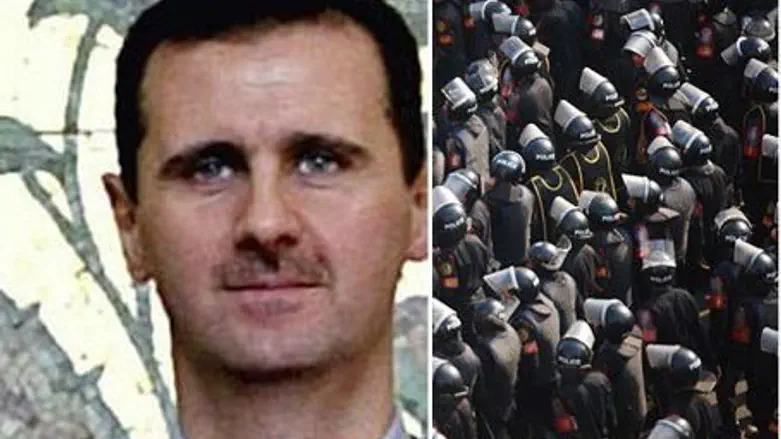
The protests that toppled the Tunisian government and threaten the Mubarak regime are a result of a regional political "disease," Syrian President Bashar Assad told The Wall Street Journal Monday.
In a rare interview, he said the movement will not spread to Syria, maintaining that “we are not Tunisians and we are not Egyptians.” Assad said that Syrians share the same ideology with his government, and added that unlike Egypt, he and his people are not pro-American or friends of Israel. Opponents to his government are planning a "Day of Rage" on Saturday.
Speaking at times like a political scientist and alternatively like a philosopher, Assad asserted that the protest movements in other countries are a result of stagnation by ruling governments.
“It means if you have stagnant water, you will have pollution and microbes,” he said. "And because you have had this stagnation for decades, let us say, especially the last decade, in spite of the vast changes that are surrounding the world and some areas in the Middle East... because we had this stagnation we were plagued with microbes.
“So, what you have been seeing in this region is a kind of disease. That is how we see it.”
Assad commented that Middle East governments must begin to understand and satisfy their citizen’s political and economic desires and that he is introducing new reforms. He skillfully deflected questions concerning arms smuggling for Hizbullah and Hamas, ties with Iran, the concept of peace and the issue of human rights in Syria, rated as one of the world's worst violators.

He also categorically denied that the military site (pictured) allegedly bombed by Israel three years ago contained nuclear material, and he accused Israel and the United States of deception in claiming otherwise.
Assad also argued that there is no question that Israel must surrender all of the Golan Heights to Syria. “This is where you start the peace process,” he explained. “You occupy the land, you want to withdraw, but to which line? It should be to the line that you crossed 40 years ago,” referring to the return of the Golan Heights to Israel in the Six-Day War in 1967.
Turning his attention to the United States, he had nice words for U.S. President Barack Obama, whom he differentiated from the American legislature and institutions.
"I think he is genuine as a person, and he believes in whatever he says." Assad said in the interview. "But in the end, you have internal politics in the United States…Those institutions do not see sometimes the interests of the United States, at least in our region, in a very realistic way.”
He cited the international community in general and the United States in particular as being an “external factor” on the movements in Tunisia and Egypt, which he said are spurred by desperation.
“Whenever you have an uprising, it is self-evident that you have anger, but this anger feeds on desperation,” according to Assad. “Desperation has two factors: internal and external….
“Regarding the West, it is about the problems that we have in our region, i.e. the lack of peace, the invasion of Iraq, what is happening in Afghanistan and now its repercussions in Pakistan and other regions. That led to this desperation and anger.”
Waxing philosophic, the Syrian dictator spoke about having an "open mind” for an entire society, noting that Syria now has Internet. He did not refer to the restrictions he has imposed on it use, especially in Internet cafes, where users must register their names on a list that police can inspect.
“We always say that we need reform but what kind of reform?” Assad continued. “If you want to make a comparison between what is happening in Egypt and Syria, you have to look from a different point: why is Syria stable, although we have more difficult conditions? Egypt has been supported financially by the United States, while we are under embargo by most countries of the world. We have growth although we do not have many of the basic needs for the people. Despite all that, the people do not go into an uprising. So it is not only about the needs and not only about the reform. It is about the ideology, the beliefs and the cause that you have.”
As for smuggling, Iran and Hizbullah, Assad maintained all of the subjects cannot be addressed without talking about peace, not only a peace treaty. “The problem with most of the officials we have from the United States during previous administrations, whether they have good or bad intentions, is that they knew very little about this region. That is why they need the support of others,” according to Assad.
“If you want to deal with Hizbullah and to deal with Hamas and even Syria, I said when you want to deal with the peace issue; if we have a peace what will happen to those parties?... So, if they do not like Iran, this does not mean that you do not have to deal with it.