
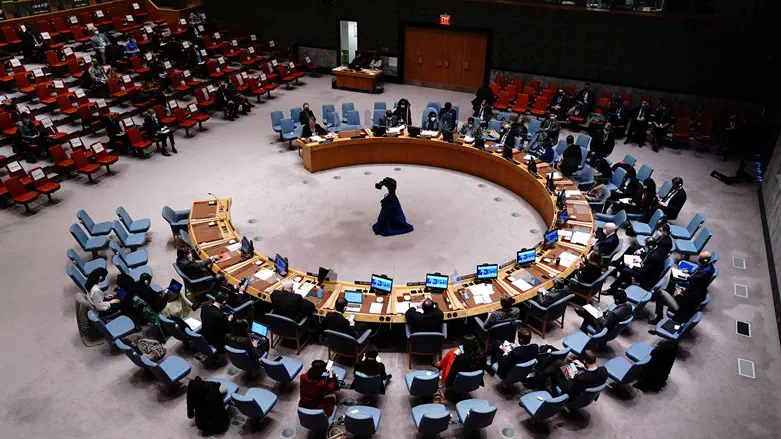
The United States, Britain, France and Germany are seeking support from other members of the UN nuclear watchdog's governing board for a resolution that would refer Iran to the UN Security Council, diplomats told Reuters on Friday.
The measure could be adopted next week by the 35-member board of the International Atomic Energy Agency (IAEA). Such a decision would mark the first time in 20 years that Iran has been reported to the Security Council over its nuclear program.
The proposed resolution would build on a measure adopted on June 12 last year, which found Iran in violation of its nuclear non-proliferation obligations because it had failed to fully cooperate with an investigation into uranium traces discovered at undeclared sites.
The push comes after the United States launched an air campaign against Tehran on February 28. The US and Israel subsequently destroyed or severely damaged several of Iran's uranium-enrichment facilities.
Since the strikes, Iran has prevented IAEA inspectors from returning to the targeted sites or determining what remains of its enriched uranium stockpile. Some of that material had been enriched to 60% purity, putting it considerably closer to weapons-grade uranium.
A referral to the Security Council would represent another escalation in the dispute between Tehran and the IAEA over access to Iran's nuclear facilities and its uranium holdings. The agency's board has already adopted two resolutions over the past year calling on Iran to declare its enriched uranium stockpiles and allow inspectors full access to verify them.
Diplomats quoted by Reuters said negotiations over the proposed resolution are still underway, and a draft has not yet been formally presented to the board. The exact wording remains under discussion, with such drafts typically submitted at the beginning of the week in which a board meeting is held.
Under the Nuclear Non-Proliferation Treaty, Iran is permitted to develop nuclear technology, including uranium enrichment, for peaceful purposes. Tehran maintains that it has no intention of developing nuclear weapons.
Iran is nevertheless the only country enriching uranium to 60% purity without possessing a nuclear bomb. The IAEA has described the quantity of uranium enriched to that level as “a matter of serious concern".
The agency estimates that well over 200 kilograms of Iran's highly enriched uranium survived the US and Israeli bombardments. The material is believed to be held in a tunnel complex at Isfahan as well as at the Natanz nuclear facility.
An agreement reached between Iran and the IAEA last September was intended to restore inspections and enable the agency to account for Iran's uranium stocks. Tehran has since declared the agreement void after Britain, France and Germany initiated the process for restoring UN sanctions that had been lifted under the 2015 nuclear agreement.
IAEA Director General Rafael Grossi recently said most of Iran's highly enriched uranium stockpile is probably still located at the Isfahan nuclear complex, which was targeted by the United States and Israel last June.
Grossi also said the IAEA is seeking access to the Natanz and Fordow nuclear sites, where additional nuclear material is believed to be located.
(Arutz Sheva-Israel National News' North American desk is keeping you updated until the start of Shabbat in New York. The time posted automatically on all Israel National News articles, however, is Israeli time.)