
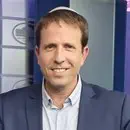
With less than a week remaining before Israel's Knesset elections, Prime Minister Benjamin Netanyahu sat down for an exclusive interview with Arutz Sheva-Israel National News to discuss the upcoming vote, his concerns about the future of the right-wing government, President Donald Trump's endorsement, the Iranian threat, and Israel's next steps in Gaza, Lebanon, and Judea and Samaria.
Speaking five days before Israelis head to the polls on October 27, Netanyahu acknowledges that he is concerned about the possibility of losing power, warning that low turnout among right-wing voters and support for smaller parties could allow the left to form the next government with the backing of Arab parties.
"I'm concerned because we're almost in an even deadlock," Netanyahu says.
The Prime Minister argues that while the left-wing parties hold approximately 40 seats in current projections, the addition of the Arab parties could provide them with sufficient support to form a government, comparing such a situation to the alliance between the far-left and Islamists in Europe. "The red-green alliance is destroying Europe. Bigger countries than Israel. Look at France. Look at Paris. Look at Britain."
"If that alliance here, the extreme left and radical Islam, the Muslim Brotherhood of Mansour Abbas and the other Arab parties, no less extreme, led by Ahmed Tibi, if they win the day and they control the government, then we're going to have the Oslo disaster on steroids," he warns.
Netanyahu identifies three major threats to the right-wing bloc's electoral prospects: complacency among voters, support for small parties that may not cross the electoral threshold, and parties that present themselves as right-wing but have not committed to supporting him as prime minister.
Addressing the possibility that right-wing voters may feel confident enough to stay home, Netanyahu warns: "If you don't show up, and the left and the Arab parties show up in much greater percentages, we lose seats."
He compares the potential loss of votes to smaller parties with the circumstances surrounding the election that brought the Oslo government to power, arguing that right-wing parties failing to cross the electoral threshold handed power to the left despite a larger number of right-wing voters.
Winter, Eisenkot, and Zelekha
Netanyahu is particularly critical of Amcha Yisrael chairman Ofer Winter, who he says has declined to commit to supporting him as prime minister.
The Prime Minister cites Winter's recent remarks that he had not decided whether to support Netanyahu or Gadi Eisenkot, as well as his subsequent statement questioning whether endorsing Netanyahu had been a mistake.
"I'm not saying what his predisposition is. I'm saying, where is he going to go? He's actually telling you, I'm not giving you a guarantee that I'll go with Netanyahu," Netanyahu says.
He warns that votes for Winter could be lost if his party fails to cross the electoral threshold, or could benefit the opposing bloc if Winter chooses to support another candidate.
"If he does pass, and he goes with his friend Liberman, for example, then he takes your vote and moves it to the left. How can you take that chance?"
Netanyahu also attacks Eisenkot, accusing him of presenting himself as a right-wing candidate despite what the Prime Minister describes as left-wing political positions.
He directs similar criticism at Yaron Zelekha, questioning his economic positions and accusing him of previously supporting the far-left Meretz party and participating in anti-government demonstrations.
Netanyahu specifically criticizes Zelekha's opposition to offshore natural gas development, which the Prime Minister credits with generating substantial revenues for Israel and lowering electricity costs.
Turning to voters considering these parties, Netanyahu states: "Don't waste your vote. Vote for Likud. Vote for MACHAL. If you want me as prime minister."
'Completely' surprised by Trump's endorsement
The Prime Minister also discusses US President Donald Trump's endorsement of his candidacy, denying reports that he had worked to secure the American President's public support.
Asked whether he had requested the endorsement, Netanyahu responds: "Never asked for it. Not once."
When asked whether he was surprised, he answers: "Completely. I didn't know."
Netanyahu recalls speaking to Trump following the endorsement.
"And when I talked to him, he said, 'You know, I wrote it myself.' And you could see that. It was very Trumpian, very cuts to the chase."
He contrasts Trump's support for his candidacy with what he describes as the support Arab political leaders are giving Eisenkot.
Iran: 'Either we destroy them, or they destroy us'
Discussing the Iranian nuclear threat, Netanyahu reiterates his position that the Iranian regime must be removed from power to eliminate the danger posed to Israel permanently.
The Prime Minister compares Iran's nuclear program to cancer, explaining that despite Israeli operations against its facilities and scientific personnel, the regime continues attempting to rebuild its capabilities.
"They're crippled. They're on their knees. But as long as this regime survives, it'll make its way back," he warns.
Asked whether Iran is currently capable of producing nuclear weapons, Netanyahu says that significant obstacles remain.
"They still have problems with weaponization, with things I won't get into."
The Prime Minister also reiterates the directive he has previously discussed publicly, instructing the Mossad and IDF to work toward the overthrow of the Iranian regime.
"There's only one way to guarantee that it's over. And that is to bring down this regime. That's the directive that I gave the Mossad and the IDF. We're going to bring them down."
When asked how Israel could accomplish such a mission, Netanyahu responds: "Well, we can. They're very weak."
"I think we can, and I know we will," he adds.
The Prime Minister also cites Trump's statements about his willingness to complete the campaign against Iran, arguing that the American President views him as the partner necessary to accomplish that objective.
Addressing a separate report that Trump had recently prevented Israel from carrying out a planned military strike against Iran, Netanyahu denies the account.
"It's an incorrect report. One day, the truth will come out," he states.
Netanyahu presents the Iranian threat as a central consideration in the upcoming elections.
"If we don't do it, you know, it's either us or this thugocracy in Tehran. Either we destroy them, or they destroy us. That's what the voters have to decide on now."
Gaza and Lebanon: 'The IDF to come in and finish it'
Turning to the Gaza Strip, Netanyahu discusses the prospects for disarming Hamas and the possibility of renewed Israeli military operations.
He says that after Israel took control of more than 60% of Gaza, he offered the United States an opportunity to assemble an international force to dismantle what remained of Hamas.
"Everybody agrees, Hamas has to be disarmed. So I said to American friends, I said, OK, you can bring some foreign power that will take Hamas apart. What's left of it, fine with me."
According to Netanyahu, Israel waited several months for such an arrangement to materialize, but no international force was assembled.
"So I think there won't be any alternative. But for the IDF to come in and finish it, just as there won't be any alternative in Lebanon, for the IDF to come and finish Hezbollah."
The Prime Minister argues that the removal of the Iranian regime would also undermine the terrorist organizations it supports.
"But imagine what happens after we finish the Iranian regime and the whole scaffolding of Hezbollah collapses. The Iranian scaffolding of Hamas collapses. We'll finish them all."
Judea and Samaria: 'There won't be a Palestinian state'
Addressing the future of Judea and Samaria, Netanyahu emphasizes his government's record of expanding Jewish communities despite opposition from previous American administrations.
"Building at a record rate," he declares.
Netanyahu recalls the pressure exerted by former US President Barack Obama against construction in Judea and Samaria, claiming that the Jewish population nevertheless nearly doubled during Obama's eight years in office.
He also points to the expansion of communities under his government in recent years, saying that 104 communities have been established, regulated, or developed.
Asked whether applying Israeli sovereignty to Judea and Samaria would be the next stage, Netanyahu confirms that the issue has been discussed with Trump but declines to announce a specific plan.
"Well, it was discussed with the president. Again, I think that you have to navigate the shoals and the whirlwinds of diplomacy carefully."
"So I'd rather do rather than announce, as opposed to some of my opponents on the right who would announce rather than do."
The Prime Minister also reiterates his opposition to the establishment of a Palestinian state.
"As long as I'm prime minister of Israel, there won't be a Palestinian state. That's a formula for our destruction. So that won't happen."
'The greatest support I have right now is in certain Arab capitals'
Netanyahu also discusses the prospect of additional peace agreements with Arab countries, arguing that the removal of the Iranian regime would create new diplomatic opportunities for Israel.
"The greatest support I have right now is in certain Arab capitals," he says.
The Prime Minister explains that this support is motivated not by affection for Israel, but by the shared threat posed by Tehran.
Addressing Arutz Sheva's American audience, Netanyahu argues that Israel's security situation demands a leader with substantial international experience.
"We're in the eye of the hurricane. And we have to be very strong and very smart and very experienced," he says.
He again criticizes Eisenkot, questioning his diplomatic and leadership experience, and cites Trump's endorsement as evidence of his own relationship with the American President.
Netanyahu concludes by returning to the elections and urging right-wing voters to consider whether their preferred candidates would ultimately support him as prime minister.
"Don't waste it on small right-wing parties that will never cross the threshold. You'll burn your vote," he warns.
"But if you don't want them, and you want me as Prime Minister, then vote for me. Because otherwise your vote will be taken and given to the left bloc."