

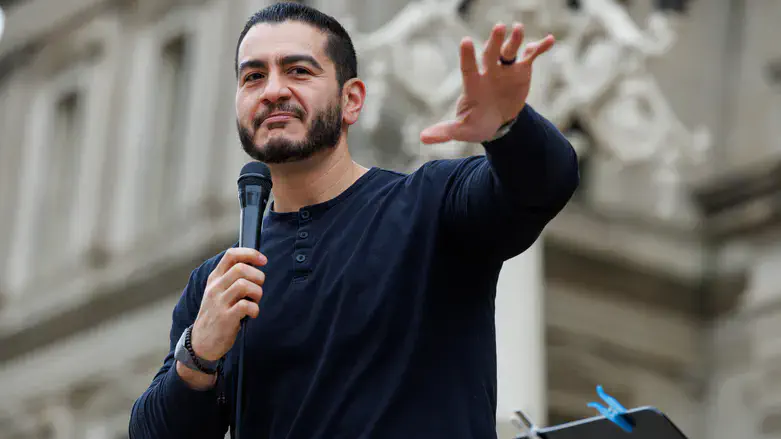
Jason Turkish, the fiancé of former Democratic Senate candidate Haley Stevens, announced Wednesday that he intends to support Republican Mike Rogers rather than Democratic nominee Abdul El-Sayed in Michigan's closely contested US Senate election, The New York Post reported, citing concerns about El-Sayed's statements on Israel and their impact on the Jewish community.
Turkish, a Jewish attorney who has contributed more than $300,000 to Democratic candidates, said his decision followed increasingly controversial remarks by El-Sayed since the August Democratic primary, in which he narrowly defeated Stevens.
He also pointed to El-Sayed's refusal during a debate with Rogers to identify whether Iran or Israel represented the greater threat to the United States.
“I’ve just seen an escalation in [El-Sayed’s] rhetoric since the primary, and it makes folks unsafe," Turkish told the Detroit News. “Every time he talks about genocide, Jews get death threats."
Turkish, whose grandparents were Holocaust refugees, accused the Democratic nominee of disregarding the consequences of his statements for Jewish Americans.
He said the country’s “never seen a candidate for US Senate act so recklessly toward the safety of Jews in the community as we have seen from Abdul."
Describing his decision to cross party lines as “putting country before party," Turkish acknowledged that supporting a Republican was particularly difficult given his longstanding Democratic affiliation and professional commitment to civil rights.
“It’s not easy. I’m a lawyer. I’m a civil rights attorney. I care a great deal about our courts. I care about the federal judiciary," Turkish said. “This is not an easy decision for me as an individual voter, but I’ve seen what’s happened, and it’s just gotten so much worse."
Turkish is legally blind and serves as managing partner of Nyman Turkish PC, a law firm specializing in disability and discrimination cases.
He and Stevens, who is not Jewish but has been a vocal supporter of Israel, first met in 2022. Their relationship developed during Stevens' primary contest against El-Sayed, and they announced their engagement less than a month after her defeat.
Asked about Turkish's decision, El-Sayed argued that the election should be decided by broader political issues, particularly control of the Senate and opposition to President Donald Trump's agenda.
“To me, this election is about control of the United States Senate. It’s about putting a check on Donald Trump. It’s about addressing his effort to try and take away everything from religious freedom to our voting rights to union rights to health care and the big ugly bill."
“So if folks see another issue that is more important to them and decide that their disagreement with me on that is bigger than their agreement with me on all these other things, that is their choice."
El-Sayed also expressed confidence in his campaign's ability to attract voters despite disagreements over individual issues.
“We feel really strong about our ability to bring people together," he added. “There are always going to be some folks who have different opinions, and they’re welcome to that. That’s the beauty of democracy."
El-Sayed's positions on Israel and his response to antisemitism have been recurring sources of controversy throughout the campaign.
During the Democratic primary, he opposed American military assistance to Israel and repeatedly avoided directly answering questions about whether Israel has a right to exist.
In one interview, he characterized Israeli military operations as "bloodthirsty" and accused the Israeli government of committing genocide.
In another conversation, he acknowledged that Hamas had committed war crimes while continuing to level accusations against Israel's leadership. He also described that leadership as "as evil as Hamas."
Last week, El-Sayed argued that Israel should no longer be regarded as an American ally, further intensifying criticism of his foreign policy positions.
Trump has also repeatedly attacked El-Sayed over his statements about Israel and the Jewish community.
On Sunday, the President expressed disbelief that Jewish voters would consider supporting the Democratic nominee.
“Any Jewish person that supports this guy should be ashamed of themselves," Trump declared. “You should never speak to them again."
“I cannot understand how anybody who’s Jewish can even think about voting for this guy," he continued, adding, "And he’ll get some."
Trump had previously denounced El-Sayed following his victory over Stevens in the August Democratic primary.
“When I watch Abdul, he’s full of s--t," Trump said at the time, describing the Democratic nominee as a “man of hate" and accusing him of hostility toward Jews.
“This guy hates Jews. Somebody said, ‘Oh, that's a little strong’. No, he hates Jews and he hates Israel…He's a man of hate. And now he's going around saying, ‘No, I love everybody.’ He doesn't love everybody. Put him in office. You're going to find out what he loves."
The President further claimed that El-Sayed “doesn't love Israel. He doesn't love Jewish people. He hates them. He hates them with a passion that burns in his heart."