

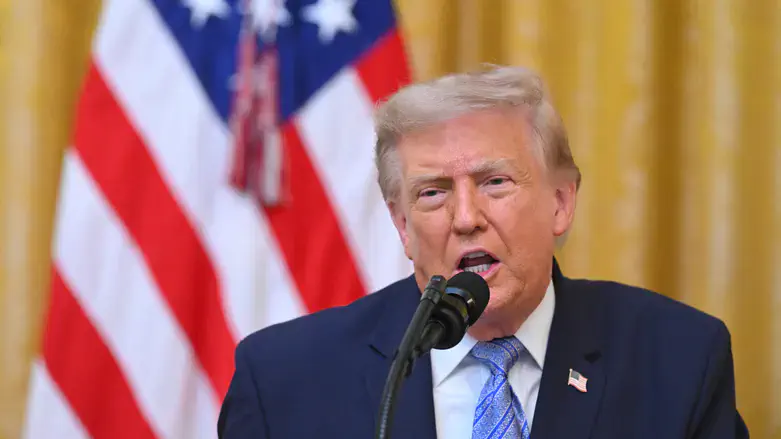
President Donald Trump could emerge weakened from the upcoming US midterm elections, potentially limiting his ability to take significant action against Iran and leaving Israel facing a more complicated security situation, Professor Zaki Shalom, a senior researcher at the Misgav Institute for National Security, has warned.
In an interview with Arutz Sheva - Israel National News, Shalom criticized Trump's handling of the confrontation with Iran, arguing that the president's inconsistent policies and repeated shifts between military threats and negotiations have undermined public confidence in his leadership.
"His biggest mistake was the constant reversals and lack of credibility," Shalom said. "Moving toward military action, stopping, shifting to negotiations, then moving toward military action again, stopping and negotiating. The public doesn't like that. It prefers a determined leader, even if that means paying more at the gas pump."
Shalom believes Trump's political standing has deteriorated partly because of his handling of Iran. Even if negotiations were intended to build public support in the United States and internationally for a potential military operation, he argued, the prolonged process and repeated changes in direction have ultimately damaged the president.
The consequences could become apparent in the midterm elections, with Republicans potentially losing ground in Congress. Such a result could make it considerably harder for Trump to secure approval for major initiatives, including prolonged military operations and fulfilling security commitments to Israel.
"We are entering a challenging period, to put it mildly," Shalom warned. "To put it less mildly, we are entering a period full of risks and complications."
He noted that even if Trump loses congressional support, the president would retain the ability to authorize limited military operations. However, a large-scale and prolonged campaign against Iran could become significantly more difficult to carry out.
Shalom was also pessimistic about the possibility that Democrats would put aside political differences and support an extended military campaign against Iran because of the threat it poses to the United States, its allies, and the international community. He argued that political considerations frequently take precedence over strategic interests, both in Washington and in Israel, and pointed to expected political changes in Michigan as an indication of the challenges that could emerge following the elections.
Shalom's criticism was not limited to Trump. He also sharply criticized Prime Minister Benjamin Netanyahu's decision to postpone military action against Iran until after the US midterm elections. According to Shalom, the decision represents an unnecessary gamble. If Trump emerges from the elections politically weakened, Israel could find itself needing substantial American assistance against Iran at precisely the moment when the president's ability to provide it is most restricted.
Asked whether an Israeli strike before the elections could have prompted accusations that Netanyahu was using military action to improve his political standing, Shalom acknowledged that such criticism would likely have emerged. Nevertheless, he argued that political considerations should not dictate decisions involving national security.
He cited Israel's 1981 bombing of Iraq's Osirak nuclear reactor, which took place shortly before Israeli elections. Then-Prime Minister Menachem Begin also faced accusations that the operation was intended to win votes.
"History is ultimately the judge, and a leader must ignore the background noise. Ultimately, Iran must be left without nuclear weapons, and we are still not in that situation. The matter remains unresolved, and it is possible that Iran will emerge victorious. The American president will remain in office and will continue to conduct military operations, but it is not certain that those operations will accomplish everything Israel wants."
Shalom also criticized the prolonged nature of Israel's military campaigns, arguing that the country has squandered one of its traditional strategic advantages: the ability to achieve decisive results within a relatively short period.
"We are conducting a war as though we have all the time in the world," he said.
Asked whether the prolonged war between Russia and Ukraine demonstrates that the era of wars ending within six days has passed, Shalom rejected the comparison. He argued that the two conflicts represent fundamentally different circumstances and maintained that Israel does not face an insurmountable military challenge in dealing with Hamas, Hezbollah and Iran. Instead, he believes political considerations have been the primary obstacle to achieving decisive results.
"This is an existential problem for Israel, and military action is necessary," he said. "History has shown that when the Americans see that we did not act on a whim, but out of concern for our security, they appreciate what we have done."
Despite his concerns, Shalom acknowledged that Trump could still defy the polls and emerge stronger than expected from the midterm elections. However, he emphasized that polling figures are only one indicator of the president's political standing. Public confidence in Trump's leadership, perceptions of his handling of national security and the economy, the cost of living and his credibility all point to growing dissatisfaction.
"The various indicators show that the public does not like what it is getting. Does the public think the alternative is better? That's a good question, and we don't have a measure for that. We will wait and see."
For Israel, however, Shalom warned, waiting could carry serious consequences. Even if Trump remains in the White House, the outcome of the midterm elections could significantly restrict his room for maneuver at a critical moment in the effort to prevent Iran from obtaining nuclear weapons.