
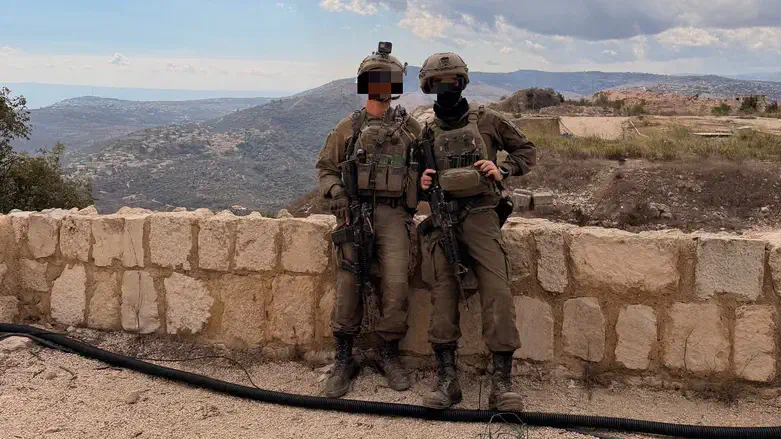
Lt. S., the intelligence officer of the 605th Battalion in the 188th Brigade, is currently deployed with troops in Lebanon, where he is responsible for gathering and analyzing intelligence and guiding forces during defensive missions and operations targeting Hezbollah infrastructure.
At just 21 years old, having already served in the Gaza Strip and Syria, he is now facing the challenges of the northern sector, where the terrain provides the enemy with numerous opportunities to conceal its activities.
In an interview with Arutz Sheva-Israel National News from Lebanon, S. described his responsibilities. "All the information comes to me, and among other things, I direct operations, whether against Hezbollah infrastructure or in areas of interest to us."
"Our primary mission is defense, in accordance with the ceasefire and the instructions we receive from our superiors," he explained. "By being in a buffer zone, we prevent the enemy from advancing toward the communities and the fence, opening fire and endangering residents."
Alongside their defensive duties, the troops work to identify and address enemy infrastructure and threats discovered in the field. This is where the intelligence officer plays a critical role, connecting information gathered from multiple sources with the troops' operational activities.
S. explained that, contrary to the common perception that intelligence work is conducted primarily away from the front lines, his position requires him to operate alongside the troops in the field. He receives information from IDF intelligence sources, analyzes it and translates it into operational guidance.
His experience in several combat arenas has given him a perspective on the differences between operating in Lebanon, Gaza and Syria. One of the most significant distinctions, he noted, is the terrain.
In Lebanon, dense vegetation and challenging terrain create particular difficulties for the troops, providing the enemy with opportunities to conceal weapons, hide infrastructure and operate undetected.
"There are far more trees and bushes here. The enemy can conceal weapons much more effectively, hide infrastructure, hide themselves and infiltrate Israeli territory," he said.
According to S., these conditions require intelligence personnel to assess not only the enemy's current location but also its potential routes, capabilities and possible movements to prevent surprise attacks.
"That is why we are here," he emphasized. "One of my roles is to provide guidance, understand and think, based on all the information sources available to me, about where the enemy will operate from and how to defend as effectively as possible."
S. also recalled a significant incident during his service in the Gaza Strip, several months before the current operations in Lebanon.
During an operation conducted by his battalion and brigade, a terrorist was captured and brought in for questioning in the field. Having studied spoken Arabic during his training, S. joined another officer who had completed the same program to question the suspect.
The two obtained intelligence not only about the area where the troops were operating but also about enemy activities elsewhere and potential threats that could affect future operations.
"We questioned him and obtained significant information, not necessarily about the area we were in, but about matters across the wider area," S. recalled. "It was very significant information that helped us understand the enemy's disposition and deal with potential threats on the ground. These were things that had an impact on the battlefield."
Asked about the qualities most essential to an intelligence officer operating on the battlefield, S. highlighted the importance of understanding the enemy and anticipating its possible actions.
He explained that an intelligence officer's responsibilities extend beyond collecting information and presenting it to commanders. The officer must understand the enemy's operational patterns, assess its intentions and identify how it might interfere with the troops' missions.
"I need to visualize the enemy," he said. "I need to understand strategically what the enemy can do, where it can have the greatest impact on me and how it can undermine my ability and the battalion's ability to accomplish the mission."
A second essential quality, he said, is initiative. Rather than waiting for commanders to request information, intelligence officers must take an active role in planning and executing operations.
"We need to know how to proactively bring the intelligence we have into the battalion's operational activities and thereby influence the battlefield as effectively as possible," he explained.
Beyond his professional responsibilities, S. also emphasized the importance of leadership. As a commander responsible for another officer and several soldiers, he must balance the demands of intelligence gathering and combat operations with his responsibility for the personnel under his command.
He explained that successfully managing operational missions while leading and caring for soldiers is an essential part of the battalion's intelligence work.
"I think that dealing with operations, intelligence and work in the field, while also looking after soldiers and commanding them, those are the things that really make the difference between winning and losing," he concluded.