


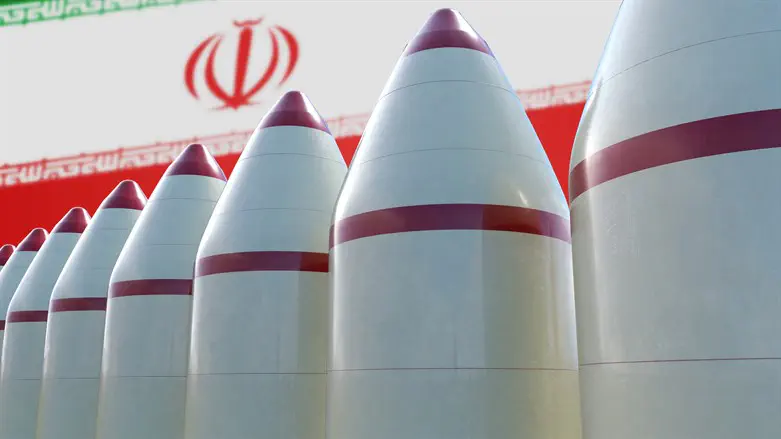
A senior Iranian military official suggested on Sunday that the religious prohibition against developing nuclear weapons could be reconsidered, as debate continues within the Islamic Republic over its nuclear policy.
Brigadier General Mohammad Jafar Asadi, deputy commander of Iran's Khatam al-Anbiya Central Headquarters, said Islamic religious rulings concerning the manufacture of nuclear bombs may change according to circumstances.
Asadi emphasized that he is not a mujtahid, an Islamic scholar qualified to independently interpret religious law, and therefore has no authority to issue a fatwa, or religious ruling, on the matter.
He explained that qualified religious scholars may reach different conclusions when interpreting Islamic law. According to Asadi, one scholar could classify a particular action as obligatory, while another might regard it as recommended or reach an entirely different conclusion.
He stressed that decisions concerning the religious permissibility of nuclear weapons must be made by qualified Islamic jurists.
The remarks come amid renewed discussion in Iran over the religious decree attributed to former Supreme Leader Ayatollah Ali Khamenei, who was killed in joint US-Israeli strikes on February 28, 2026.
Khamenei's fatwa, dating to the early 2000s, declared nuclear weapons forbidden under Islamic law. Iranian authorities repeatedly cited the ruling to support their insistence that the country's nuclear program was intended exclusively for peaceful purposes.
In August 2005, Iran formally referenced the decree during an emergency meeting of the International Atomic Energy Agency (IAEA), declaring that the production, stockpiling, and use of nuclear weapons were prohibited under Islam.
The decree became a central part of Tehran's public position on nuclear weapons, although questions have been raised over its precise wording and religious authority.
In April 2025, Ali Larijani, then an adviser to Khamenei, warned that an American or Israeli attack could force Iran to develop nuclear weapons despite the religious prohibition.
More recently, Iranian lawmaker Mohammad-Saleh Jokar called on the country's leadership to authorize nuclear weapons as a deterrent against further US military strikes.
The discussion intensified following Khamenei's death and amid continuing tensions over Iran's nuclear ambitions.
On November 13, former senior Mossad official Haim Tomer pointed to statements from Iranian officials indicating that factions within the regime were seeking to overturn the longstanding nuclear fatwa.
Asadi's latest remarks did not announce a formal reversal of the religious prohibition, but raised the possibility that qualified Iranian religious authorities could reach a different ruling on the development of nuclear weapons.