

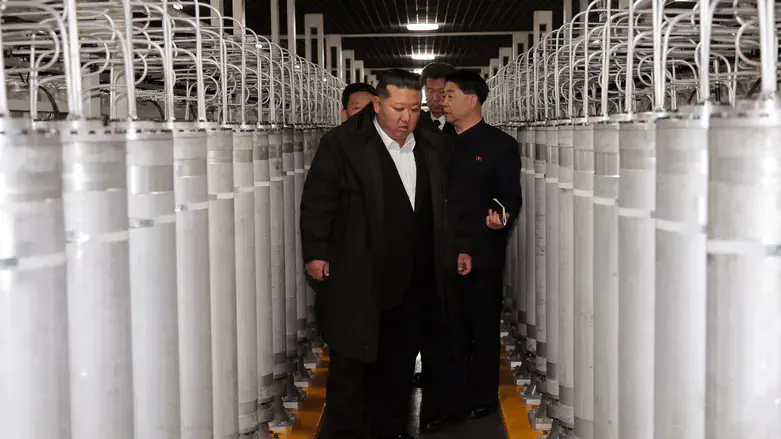
North Korean leader Kim Jong Un reaffirmed his commitment to expanding Pyongyang's nuclear arsenal, declaring that the country's status as a nuclear weapons state was "absolutely inviolable", state news agency KCNA reported on Wednesday.
Speaking during a visit to nuclear material production and weapons research facilities, Kim said North Korea was systematically increasing its capacity to produce nuclear material. KCNA did not disclose the names or locations of the facilities.
"Our nuclear capability is now a reality," Kim declared, dismissing international calls for Pyongyang to abandon its nuclear program as "denuclearization rhetoric from forces that ignored objective reality and failed to recognise the changed situation."
The North Korean leader said his country should "focus on utilizing tactical nuclear weapons across multiple domains for different missions" and hailed recent advances in weapons production as a significant achievement.
Kim warned that challenging North Korea's nuclear status, which was incorporated into the country's constitution in 2023, would be considered "an open declaration of war".
"Our possession of nuclear weapons is an absolutely irreversible choice as long as malicious forces exist that use nuclear weapons as a means of achieving hegemony," Kim said.
Pyongyang has carried out six nuclear tests since 2006, the most recent and powerful of which took place in 2017.
In August, South Korea's defense minister said estimates placed North Korea's nuclear arsenal at between 80 and 120 warheads, while stressing that the figures were based on independent research and had not been officially verified.
North Korea has continued to demonstrate its expanding military capabilities in recent months, announcing tests of two types of submarine-launched cruise missiles following several hypersonic missile tests.
Meanwhile, diplomatic efforts to address Pyongyang's nuclear ambitions remain stalled. Kim has effectively severed dialogue and cooperation with South Korea, designating the neighboring country a permanent enemy.
North Korea has also shown no willingness to accept US President Donald Trump's efforts to revive negotiations that collapsed in 2019.
Trump expressed optimism in August about holding another meeting with Kim before the end of the year.
Asked whether he expected another encounter with the North Korean leader, Trump replied, “Yeah, I will."
However, he refused to disclose whether the two had resumed their correspondence, saying, “I can’t tell you that."
Trump met Kim three times during his first presidential term, beginning with their historic summit in Singapore in 2018. A second summit took place in Vietnam the following year.
In 2019, Trump also became the first sitting American president to set foot in North Korea, crossing the Demilitarized Zone separating the two Koreas.
Despite those unprecedented diplomatic encounters, Washington and Pyongyang failed to reach a binding agreement on limiting or dismantling North Korea's nuclear arsenal.
Last month, North Korean authorities published photographs of Kim visiting a clothing and footwear showroom in Pyongyang alongside his 13-year-old daughter, Kim Ju Ae, apparently seeking to dispel unconfirmed reports that the leader had died following a brain hemorrhage.