


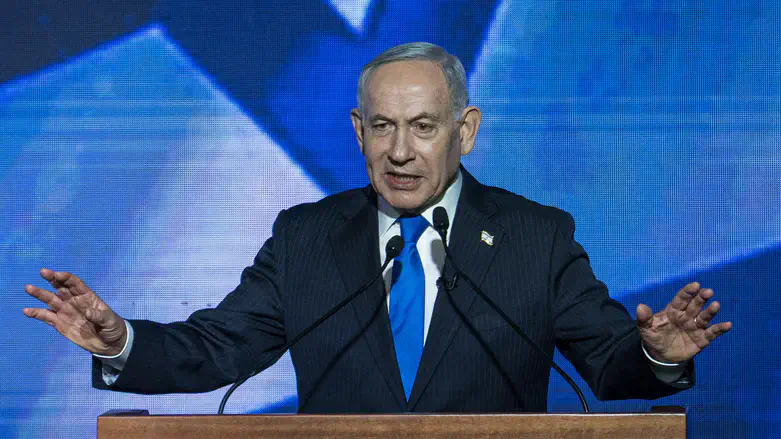
Prime Minister Benjamin Netanyahu's proposal to form a unity government with Gadi Eisenkot, with Eisenkot serving as prime minister first in a rotation agreement, drew a mix of support and skepticism from politicians across the political spectrum.
Supporters of the proposal praised Netanyahu's willingness to make concessions in the interest of national unity, while opponents questioned his motives and called instead for a government led by Eisenkot.
Religious Zionism chairman and Finance Minister Bezalel Smotrich welcomed Netanyahu's proposal, describing it as "real and sincere." Smotrich said he had been involved in the deliberations and decision-making on the matter in recent days.
Smotrich said he was prepared to guarantee any agreement Netanyahu reaches with Eisenkot and his partners, and called on Eisenkot and Zionist members of the Knesset on the Left to abandon the prospect of a minority government and "extend a hand back to our brothers and establish a broad national unity government."
Education Minister Yoav Kisch also welcomed the proposal, framing it as a test for the Left. "This is the moment of truth for the Left bloc. Does your love for Israel outweigh your hatred of Netanyahu?" he asked.
MK David Peter described Netanyahu's offer as a "historic leadership move," saying the Left was at a crossroads between Zionist unity and what he characterized as the realization of the ambitions of Hassan al-Banna and Yusuf al-Qaradawi at Israel's expense.
Culture and Sports Minister Miki Zohar expressed reservations about Netanyahu's willingness to allow Eisenkot to serve as prime minister first, but nevertheless praised the move. "Although I find it difficult to accept Netanyahu's position of allowing Eisenkot to begin first as prime minister, I can only say that he is demonstrating exceptional leadership and once again showing how Israel has always been at the top of his priorities," Zohar wrote.
Former prime minister and Beyachad party chairman Naftali Bennett welcomed Netanyahu's announcement, supporting a unity government led initially by Eisenkot. Bennett said the government should be based on parties representing the Zionist public that serves in the military.
Bennett warned against attempts to delay the process, saying, "We will proceed according to the principle: Respect him, suspect him, and suspect him again. And above all, quickly."
Bennett outlined several principles for the proposed unity government, including establishing a state commission of inquiry, limiting the prime minister's tenure to eight years, reaching agreements on judicial reform while freezing the implementation of the judicial overhaul legislation, advancing reforms benefiting military servicemen and women, and addressing the IDF's needs.
Communications Minister Shlomo Karhi praised Netanyahu for demonstrating national responsibility and placing Israel's security above all else. Karhi called on leaders of the opposing political camp to overcome their differences and agree to establish a national unity government that evening.
"The people of Israel are expecting a decision. History will judge those who, at a moment of truth, turn their backs on the State of Israel and choose to join those who seek its harm," Karhi said.
Likud MK Eli Goldschmidt also backed Netanyahu and urged Eisenkot to accept the proposal.
"The prime minister lit the first Hanukkah candle early, the candle of unity and brotherly love, the candle that will turn hatred into love," Goldschmidt said. "Eisenkot, please take up the offer."
MK Meir Porush likewise supported Netanyahu's willingness to make concessions to establish a unity government, urging Eisenkot to accept. Porush said unity was the preferred option at a time when Israel faces serious threats, adding that sensitive issues important to the Haredi public could also be resolved through a period of dialogue and reconciliation.
Democrats chairman Maj. Gen. (res.) Yair Golan rejected Netanyahu's proposal, calling instead for the establishment of a change and rescue government. "Enough with the tricks and gimmicks. Netanyahu lost. It is our duty to respect the voters' wishes and establish a change and rescue government," Golan said.
Yair Lapid, chairman of Yesh Atid and No. 2 on the Beyachad party list, also dismissed Netanyahu's offer, calling it another transparent political maneuver by what he described as a serial fraudster who had deceived every partner and violated every agreement. Lapid said the only way to test Netanyahu's proposal would be to first swear in a government headed by Eisenkot, after which negotiations could take place over expanding it.
Joint List chairman Yousef Taysir Jabareen rejected Netanyahu's unity proposal as well, accusing the prime minister of recycling political spin in an effort to thwart a change of government. Jabareen called for Netanyahu's government to be replaced, saying, "It is time to realize the shared will of the entire public, Jews and Arabs alike, and oust Netanyahu this week."