

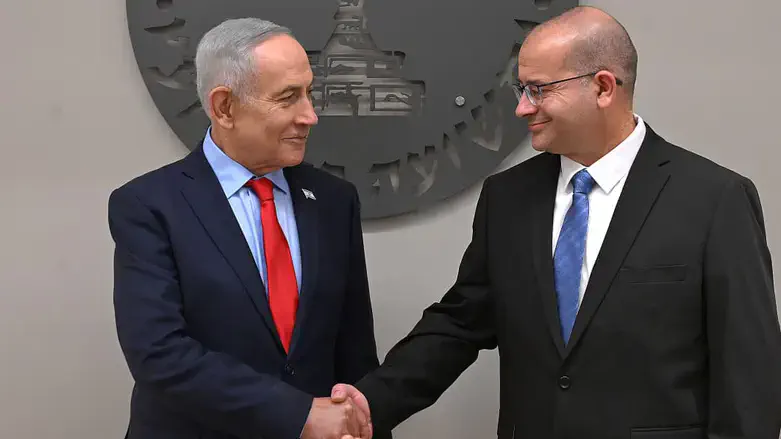
Mossad chief Roman Gofman held a phone call with Syrian Foreign Minister Asaad al-Shaibani last week in which the two discussed Turkey's military presence in Syria, Reuters reported Wednesday, citing three people familiar with the matter.
The call took place on August 14, according to the sources, days before Israel carried out airstrikes on the Abu al-Duhur airbase in the eastern Idlib countryside.
The reported conversation marks one of the highest-level contacts between Israel and Syria's new government since the fall of former Syrian dictator Bashar al-Assad in December 2024.
The Prime Minister's Office, which handles inquiries concerning the Mossad, confirmed the security issue behind the strikes in a statement on Tuesday evening.
"Israel and Syria agreed to a status quo in security matters, which Syria was on the verge of breaching by permitting Turkish troops to deploy at an airbase near Aleppo," the Prime Minister's Office said.
"Israel repeatedly warned Syria that such a deployment would pose a threat to Israel's security. Syria chose to ignore these warnings. Israel will not tolerate threats to its security, and would welcome a return to the status quo," the statement added.
Prime Minister Benjamin Netanyahu addressed the strike on Wednesday and made clear that Israel opposes a Turkish military buildup in Syria.
“We will not tolerate a Turkish military presence in Syria that threatens Israel. We made the message clear: Don’t. Apparently, they didn’t hear it clearly enough, so we made sure they understood it better," he said.
Arab media reported that four airstrikes hit the runway at Abu al-Duhur early Tuesday morning. The aircraft involved were not identified, and the reports said the strikes caused material damage to the runway without causing injuries.
On Wednesday, IDF Chief of Staff LTG Eyal Zamir visited the 210th Division and toured the security zone in southern Syria, where he warned that Israel would not allow hostile forces or significant military threats to establish themselves along its borders.
"We see what is happening and are monitoring the changes on the Syrian front - we must prepare for them accordingly. We will not allow hostile forces to establish themselves on our borders, and we will know how to use our operational capabilities precisely where and when needed," Zamir said.
Zamir said the IDF must address both terrorist infrastructure and the emergence of a conventional military threat near Israel.
"We must prevent the development of terrorist threats, while also preventing the formation of a significant military threat on our borders," he said.
"We are still in a multi-front war, alert and operating in all arenas - escalation can develop in any one of them, and we must remain in constant readiness for that," the Chief of Staff said.
He also praised the 210th Division and reservists serving in the sector, noting the burden carried by troops who have accumulated hundreds of days of reserve duty since the beginning of the war.
"The entire people of Israel are deeply indebted to you," Zamir concluded.